
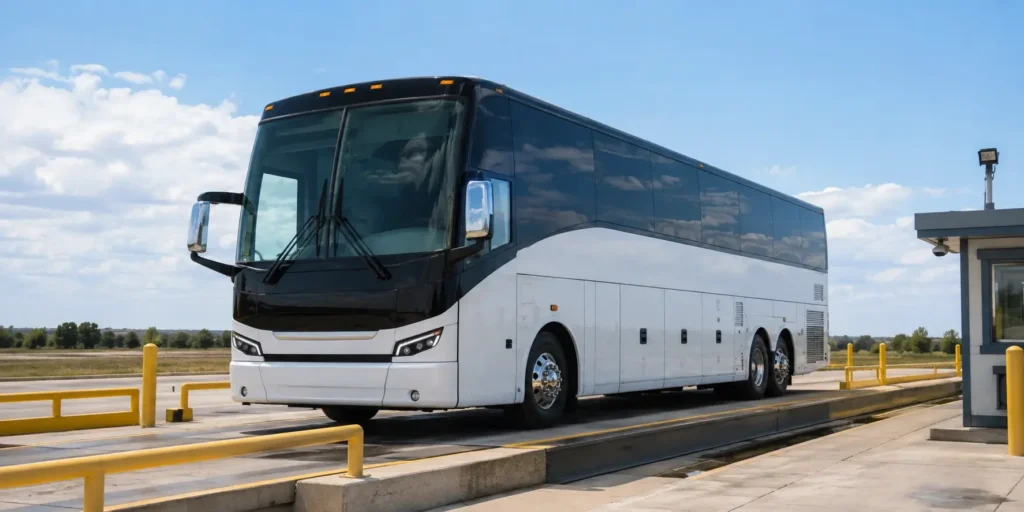
How Much Does a Charter Bus Weigh?
A standard full-size charter bus typically weighs about 33,000 to 45,000 pounds when empty, or roughly 16.5 to 22.5 tons. Once passengers, luggage, fuel, and other equipment are added, the total operating weight rises. Many large motorcoaches have a Gross Vehicle Weight Rating, or GVWR, between approximately 45,000 and 56,000 pounds.
That range is wide because buses vary by length, chassis, seating capacity, storage, fuel capacity, and interior equipment. A full-size motorcoach can therefore weigh far more than a minibus or passenger Sprinter van.
Charter Bus Weight at a Glance
The table below compares several common group transportation vehicles. Exact figures vary by model and configuration.
| Vehicle Type | Typical Capacity | Approx. Empty Weight | Approx. Loaded Weight/GVWR |
|---|---|---|---|
| Full-size charter bus | 40-56+ passengers | 33,000-45,000 lbs | 45,000-56,000 lbs |
| Minibus | 18-30 passengers | 10,000-15,000 lbs | 14,000-19,500+ lbs |
| Shuttle/Sprinter from | Up to 15 passengers | 7,000-10,000 lbs | 10,000-12,000+ lbs |
These are planning ranges, not the exact weight of every vehicle. For precision, use the vehicle data plate and manufacturer specifications.
How Much Does a Full-Size Charter Bus Weigh?
Most people asking this question are thinking about the large motorcoaches used for tours, sports teams, corporate groups, long-distance trips, and major events. These buses commonly carry around 40 to 56 passengers and may be about 45 feet long.
An empty full-size coach often falls in the 33,000 to 45,000-pound range. A full passenger load can add several thousand pounds, followed by suitcases, diesel fuel, fluids, equipment, and restroom tanks.
This is why maximum rated weight should not be confused with empty weight. A motorcoach with a 54,000-pound GVWR does not automatically weigh 54,000 pounds every time it travels.
Charter Bus Weight in Pounds, Tons, and Kilograms
Converting the same bus weight into different units makes U.S. and international specifications easier to compare.
Charter Bus Weight in Pounds
A standard full-size charter bus is commonly around 33,000 to 45,000 pounds empty. Its maximum rated weight may reach roughly 45,000 to 56,000 pounds, depending on the vehicle.
Charter Bus Weight in Tons
One U.S. ton equals 2,000 pounds, so a 33,000 to 45,000-pound empty charter bus weighs approximately 16.5 to 22.5 tons. A 54,000-pound maximum rated weight equals 27 tons.
Charter Bus Weight in Kilograms
A 33,000-pound bus weighs about 15,000 kilograms, while a 45,000-pound bus is roughly 20,400 kilograms. A 54,000-pound rating is approximately 24,500 kilograms.
Curb Weight vs. GVWR: What Do the Numbers Mean?
Different vehicle listings use several weight terms, and mixing them up can make a bus appear much heavier or lighter than it really is. Understanding three basic terms makes the numbers much clearer.
Curb or Empty Weight
Curb weight generally describes the vehicle itself with standard equipment and operating fluids. Definitions can vary slightly by manufacturer, but this is the figure closest to what most people mean by an empty bus.
Gross Vehicle Weight
Gross vehicle weight is the bus’s actual total weight at a particular moment. It can include the driver, passengers, luggage, fuel, fluids, equipment, and other cargo.
Because the load changes, gross vehicle weight can be different from one trip to the next.
Gross Vehicle Weight Rating
GVWR is the maximum total operating weight the manufacturer has rated the vehicle to handle. It is a limit, not a statement of what the bus currently weighs.
A simple way to understand available carrying capacity is:
Available payload = GVWR minus empty or curb weight
Passengers, baggage, equipment, and other added items all use part of that available payload.
What Adds Weight to a Charter Bus?
Passenger count is only one part of the total. A bus can gain several thousand pounds after everyone and everything needed for the trip is onboard.
Common sources of additional weight include:
- Passengers: A full group can add several thousand pounds.
- Luggage and equipment: Suitcases, instruments, sports gear, and event supplies can fill storage bays quickly.
- Diesel fuel: A full tank adds hundreds of pounds.
- Water and restroom tanks: Fresh water and wastewater add more weight.
- Amenities: Heavy seating, wheelchair lifts, climate systems, entertainment equipment, and luxury upgrades affect base weight.
Two similar-looking buses can still have different empty weights and payload capacities.
How Heavy Are Other Types of Group Vehicles?
“Bus” covers many different vehicles. A motorcoach, minibus, school bus, party bus, and passenger van may have completely different chassis, passenger capacities, and weight ratings.
Minibus
Many 18- to 30-passenger minibuses weigh around 10,000 to 15,000 pounds empty, although larger or heavily equipped models can weigh more. They are useful when a group needs more capacity than a van without requiring a full-size coach.
Sprinter Van or Shuttle Van
Passenger Sprinter vans are smaller again. Depending on configuration, many fall around 7,000 to 10,000 pounds empty, with higher gross ratings once people and cargo are added.
For groups that do not need a 40- or 50-passenger coach, a luxury Sprinter van rental in Nashville can provide group seating and luggage space in a more compact vehicle.
How Much Weight Do Passengers and Luggage Add?
If 50 passengers average 175 pounds each, their combined body weight alone adds about 8,750 pounds.
Luggage adds more. A group carrying one or two bags each can add hundreds or even more than a thousand pounds depending on the trip. Touring musicians, sports teams, and conference groups may also bring heavier equipment.
Passenger and luggage counts matter when choosing a vehicle, too. Groups arriving with many bags should share those details when arranging Nashville airport transportation so the vehicle can match both seating and storage needs.
How Long Is a Charter Bus?
A standard full-size charter bus is commonly around 40 to 45 feet long, with 45 feet being a familiar size for modern motorcoaches. Smaller coaches and minibuses can be considerably shorter.
Length does not reveal exact weight, but larger vehicles generally have more structure, seating, storage, fuel capacity, and equipment. Vehicle dimensions also affect pickup areas, venue entrances, parking lots, and loading zones.
For event planners, this can determine whether a motorcoach, Nashville party bus, or Sprinter is the practical choice.
Why Does Charter Bus Weight Matter?
For passengers, bus weight usually stays in the background. For operators and trip planners, it affects routing, legal limits, handling, fuel use, access, and vehicle selection.
A heavy motorcoach may face restrictions on certain roads, bridges, parking structures, or private properties. Weight also influences vehicle handling and stopping.
The largest vehicle is not automatically the best choice. Passenger count, luggage, stops, and destination all matter.
Choosing the Right Group Vehicle in Nashville
Sprinter Van Nashville provides chauffeured transportation for airport transfers, weddings, private outings, corporate travel, tours, and celebrations across Nashville and Middle Tennessee. For smaller and mid-sized groups, a Sprinter can keep everyone together without using a full-size motorcoach while a professional chauffeur handles traffic, parking, and timing.
For sightseeing or multi-stop plans, private group transportation in Nashville can be matched to the itinerary and passenger count. Wedding groups moving between hotels, ceremonies, and receptions can likewise use coordinated wedding transportation in Nashville rather than choosing a vehicle based only on size.
If you are comparing motorcoaches with smaller options, the Nashville Sprinter van rental guide also explains how passenger count, luggage, service type, and trip details affect vehicle selection.
How to Find the Exact Weight of a Charter Bus
Online averages cannot tell you exactly what one bus weighs. Seating layout, equipment, amenities, and modifications can change the figure.
For a precise number, check the manufacturer’s specifications and the vehicle certification or data plate. GVWR and axle ratings are listed for the specific vehicle. A certified scale is needed to determine its actual loaded weight at a particular moment.
Frequently Asked Questions
How Much Does a Charter Bus Weigh in Pounds?
A standard full-size charter bus commonly weighs around 33,000 to 45,000 pounds empty. Depending on the model, its GVWR may be roughly 45,000 to 56,000 pounds.
How Much Does a Coach Bus Weigh in Tons?
A full-size coach weighing 33,000 to 45,000 pounds is approximately 16.5 to 22.5 U.S. tons when empty. Its fully loaded or maximum rated weight can be higher.
How Much Does a 56-Passenger Charter Bus Weigh?
Many 56-passenger motorcoaches fall within the general full-size range of about 33,000 to 45,000 pounds empty. The exact number depends on the manufacturer, equipment, and seating configuration.
What Is the Difference Between Bus Weight and GVWR?
Actual bus weight is what the vehicle weighs at a specific moment. GVWR is the maximum total operating weight the manufacturer permits, so the bus normally weighs less than its GVWR.
How Much Does a Minibus Weigh?
Many minibuses weigh approximately 10,000 to 15,000 pounds empty, although size, chassis, seating, and equipment can move the figure higher.
How Much Does a Sprinter Van Weigh?
Passenger Sprinter vans often weigh roughly 7,000 to 10,000 pounds empty, depending on model and configuration.
Does Luggage Make a Major Difference in Charter Bus Weight?
Yes. Suitcases, instruments, sports equipment, and other cargo can add hundreds or thousands of pounds. The complete load must remain within the vehicle’s rated limits.

